
Climate financing: an important lever for mitigating climate change
International climate financing will again take centre stage at COP30, this year's climate change conference in Belém. Such financing is a decisive lever for mitigating global warming and thus keeping the 1.5°C objective within reach, and for supporting the countries suffering the most from the consequences of climate change. Switzerland supports the implementation of the Paris Agreement with international climate financing, and international cooperation plays a key role here.

The Conference of the Parties (COP) is the annual UN climate change conference, which brings together the parties to the UN Framework Convention on Climate Change. This year's conference, COP30, will take place from 10 to 21 November in Belém, Brazil, and will gather representatives from governments, academia, the private sector and civil society. The parties to the agreement will negotiate further goals and measures for climate change mitigation. Switzerland will also take part in the negotiations with a delegation led by the Federal Office for the Environment (FOEN), representatives from other federal offices, and the Swiss Agency for Development and Cooperation (SDC).
In their negotiations to date, the parties have not only agreed on the urgency of taking action in view of advancing global warming, but also on specific targets, standards and mechanisms. The 1.5°C objective was set within the framework of the Paris Agreement adopted at COP21 in 2015. The Paris Agreement obliges all its parties to reduce their greenhouse gas emissions. To this end, each party must make its nationally determined contribution (NDC) more ambitious every five years, implement corresponding measures, and report regularly on progress.

The countries that signed the agreement are now being asked to submit new or updated NDCs to show that they are stepping up their efforts to help limit global warming to 1.5°C. Switzerland advocates that all countries – especially major emitters – submit new, ambitious climate targets. It also calls for these targets to be specific and verifiable and to help meet the 1.5°C objective.
Financing for the 1.5°C objective
In many countries, especially those that are major emitters and producers of fossil fuels, there is a lack of political will to step up efforts. Moreover, many countries face major challenges in implementing measures towards reaching their climate targets. The funds for implementing the NDC-defined climate goals are limited, and the political framework and measures to achieve them have not yet been established. Countries that suffer most from the consequences of climate change will be particularly affected if the 1.5°C objective is not achieved. Crop failures due to droughts, forest fires caused by dry spells, and landslides and flooding triggered by heavy rainfall are drivers of poverty, hunger, conflict and displacement, and thus hinder development.
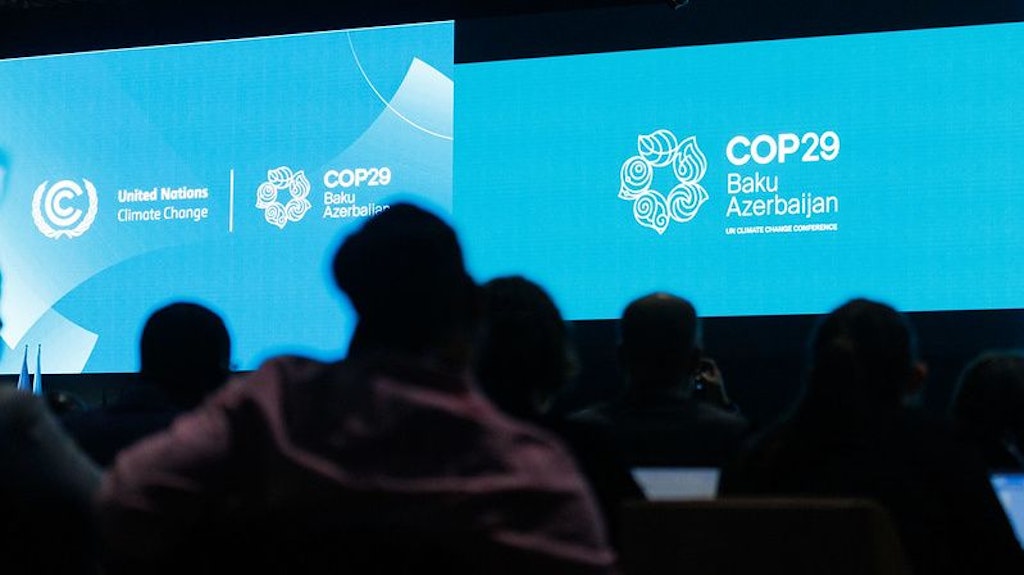
That is why advanced economies are supporting developing and emerging countries in implementing their climate targets and increasing their adaptive capacity. At last year's climate conference in Baku (COP29), the parties agreed to triple the current USD 100 billion annual target for financing climate change mitigation and adaptation in developing countries to USD 300 billion by 2035. This amplified target is part of the New Collective Quantified Goal on Climate Finance (NCQG), with which the international community aims to pursue measures towards achieving the 1.5°C objective. In addition, all state and non-state actors are called upon to facilitate investments of USD 1.3 trillion by 2035 for climate action in developing countries.
Switzerland supports this financing target and takes the position in the negotiations that the donor country base should be expanded – in particular by including high-emitting countries with more powerful economies – and that additional private capital must also be mobilised. Public funds alone will not be enough to achieve the NCQG and the targets by 2050. Investing in mitigation costs far less than addressing the consequences of inaction, and the funds for this must be mobilised on as broad a base as possible. While climate change adaptation measures must be taken, priority should be given to preventing global warming.
In 2017, the Federal Council set Switzerland's appropriate share of the then USD 100 billion target at CHF 450-600 million, based on Switzerland's share of global emissions and its economic performance. The majority of Switzerland's climate financing to date, over CHF 360 million, comes from the international cooperation budget, namely the bilateral and multilateral cooperation of the SDC.
International cooperation: for climate and development
In addition to its own national measures to reduce emissions, Switzerland is contributing to the achievement of global climate goals through its climate financing.Switzerland's international cooperation ensures that sustainable projects are realised in developing countries and that local people benefit from them. This provides effective support to the communities and countries most affected by climate change and helps to limit global warming to a maximum of 1.5°C.
International climate financing is used to implement measures to reduce emissions and adapt to the consequences of advancing climate change. The SDC supports both approaches, with a focus on adaptation programmes. ‘Climate and environment’ is one of the four objectives of Switzerland's International Cooperation Strategy 2025–28. The SDC and SECO support bilateral development projects and work together with multilateral partner organisations and funds such as the Green Climate Fund (GCF) and multilateral development banks.
COP30 in Belém
Multilateral forums such as the Conference of the Parties (COP) are important because they allow government representatives, scientists, the private sector and civil society to come together, negotiate and agree on realisable targets for reducing greenhouse gas emissions. The main topics at COP30 will be the new NDCs of the parties up to 2035. For its part, Switzerland is committed to ensuring that all parties submit ambitious climate targets for 2035 that are in keeping with the 1.5°C objective. Switzerland submitted its new, more ambitious climate target in January 2025. It is also committed to strengthening private investment in the climate sector and increasing the effectiveness of international cooperation for climate action.
Strengthening multilateral mechanisms and rule-based systems is in Switzerland's interest. Global warming can only be reduced through joint efforts; the challenges entailed cannot be solved by going it alone – we are all affected by the consequences of climate change. The SDC and its partner organisations are doing their part to ensure that the global 1.5°C objective remains within reach.
Contact
Eichenweg 5
3003 Bern