
Central African Republic
After years of conflict, the Central African Republic is now seeking a return to peace and development. As the country remains fragile and affected by extreme poverty, the SDC is engaged in improving protection for civilians, strengthening access to basic services and promoting peace and reconciliation.
Context Central African Republic
The Central African Republic faces many challenges. Despite significant advances in security in certain areas of the country, the persistence of inter-community conflicts and the country's proximity to countries in conflict are affecting efforts to stabilise institutions and rebuild the country. Successive conflicts have destroyed basic social services and civilian infrastructure and caused major population displacements. More than one third of the population continues to need humanitarian aid, with women and children being particularly vulnerable.
After running its humanitarian assistance programmes ‘remotely’ for many years, the Swiss Agency for Development and Cooperation (SDC) opened a humanitarian office in Bangui in 2022. The SDC focuses on three areas of intervention: protecting civilians, improving access to basic services and promoting peace and reconciliation. It also aims to strengthen coherence between humanitarian, development and peacebuilding efforts, while supporting local governance systems and gender equality.
Protection of civilians
Through its cooperation activities, the SDC promotes respect for international humanitarian law and human rights. It ensures that the UN Humanitarian Country Team keeps protection at the heart of its priorities and promotes respect for the humanitarian principles, including access and protection of humanitarian personnel, premises and assets with the authorities of the Central African Republic and other stakeholders. By supporting the UN Country-based Pooled Fund, it helps to improve coordination between agencies and represents donors within its Advisory Board. The office in Bangui also ensures that international and local humanitarian organisations benefit from a regulatory framework that favours their activities. For the period 2026–2029, the SDC's work will pay particular attention to the multi-sectoral response to support survivors of conflict-related gender-based violence, with measures including reconstructive surgery, psychosocial support and income-generating activities.
Provision of basic services
The SDC's investments in basic services complement those of international financial institutions and of the CAR's bilateral partners. They help to make basic services accessible to everyone throughout the country, in line with the CAR's National Development Plan 2024–2028. In particular, the Swiss cooperation programme works to improve para-medical training infrastructure in several regions of the country, while also supporting training for healthcare personnel, particularly in rural areas. It also supports innovative capacity development initiatives strengthening the healthcare system in the long term.
Peace and reconciliation
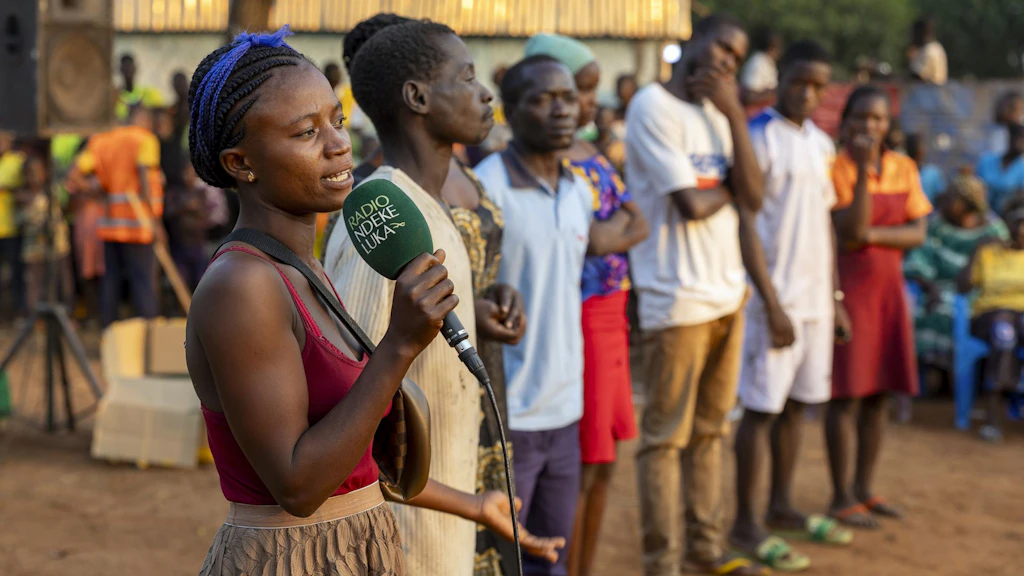
The SDC is closely monitoring developments in the CAR and its neighbouring countries. It supports projects that strengthen social cohesion, in particular by facilitating access to high-quality information throughout the country via multi-year financial support for the Fondation Hirondelle/Radio Ndeke Luka. It is also supporting transparent, inclusive and fair elections in the CAR by contributing to a multi-donor trust fund managed by the UNDP. In addition, Switzerland supports the Special Criminal Court (SCC), established to investigate and prosecute war crimes committed in the CAR. This important contribution to fighting impunity and promoting peace is managed by the Peace and Human Rights Division of the FDFA's State Secretariat.
Approach and main partners
Swiss cooperation gives priority to dialogue with all its partners in the Central African Republic and internationally and is firmly committed to humanitarian principles, respect for international humanitarian law and human rights. It develops partnerships with civil society organisations and NGOs in the Central African Republic in consultation with international partners (UN, ICRC and NGOs) present in the country.
Contact
Eichenweg 5
3003 Bern