
Humanitarian support as part of the Gaza Peace Plan
A fragile ceasefire has been in place in the Gaza Strip since 10 October 2025. Humanitarian aid has been increased, but still falls far short of what is needed, as the scale of the emergency and needs on the ground remain enormous. Ongoing restrictions continue to limit the access of humanitarian actors to the Gaza Strip and the access of the population to basic goods. Meanwhile, the situation in the West Bank is further escalating. Living conditions among the civilian population are increasingly deteriorating due to the continued expansion of illegal settlements and settler violence, growing violence by the Israeli security forces, and the related increase in the destruction of homes and forced displacement. The Swiss Agency for Development and Cooperation (SDC) is continuing its cooperation with humanitarian partner organisations to meet the acute needs of the civilian population throughout the occupied Palestinian territory (oPt).
On 26 November 2025, the Federal Council decided to allocate an additional CHF 23 million to support the ‘Gaza Peace Plan for peace in the Middle East’ put forward by the US. The funds go towards humanitarian aid in the Gaza Strip, the strengthening of Palestinian institutions and the promotion of dialogue. Since November 2023, Switzerland has provided a total of around CHF 150 million for humanitarian aid in the oPt. The aid is delivered exclusively by humanitarian actors who respect the humanitarian principles of humanity, neutrality, impartiality and independence.
Humanitarian aid
As part of the package agreed on 26 November 2025, the FDFA allocated CHF 12 million to the United Nations Office for the Coordination of Humanitarian Affairs (OCHA), the International Committee of the Red Cross (ICRC) and the Palestine Red Crescent Society (PRCS) – via the Swiss Red Cross (SRC) – in the oPt and to the Jordan Hashemite Charity Organization (JHCO) in Jordan.
Based on needs analysis, OCHA uses a strategic funding mechanism to channel available funds to vetted partners in priority areas such as water, health and emergency shelters. Immediately after the start of the ceasefire, for example, OCHA contributed to the implementation of the UN 60-day ceasefire plan, which aimed to increase UN-coordinated humanitarian aid in all sectors.
The contribution to the ICRC supports the organisation's urgently needed and life-saving humanitarian activities in the oPt, such as the operation and expansion of the ICRC field hospital in the Gaza Strip, which as of October 2025 was providing surgical treatment as well as gynaecological and paediatric care with a capacity of around 120 beds.
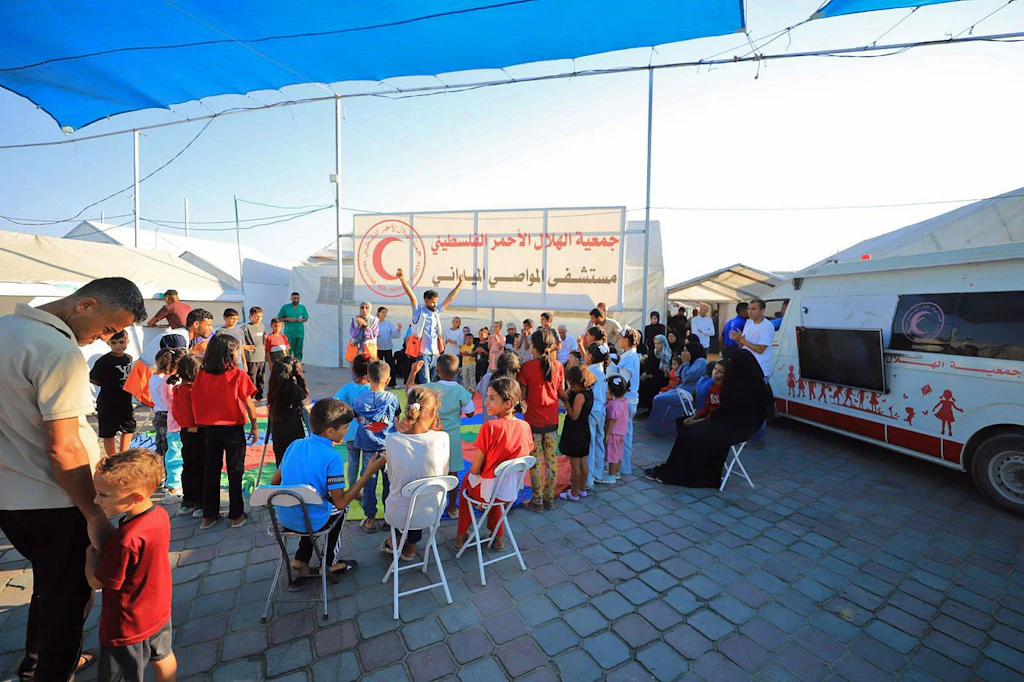
Among other things, the PRCS operates rescue and ambulance services, provides emergency medical care and offers psychosocial support. As of November 2025, the PRCS was operating 16 medical care centres and emergency clinics as well as two hospitals and two field hospitals offering basic medical care. In Khan Younis, for example, a centre specialising in medical rehabilitation with around 100 beds was opened. Since mid-January 2026, the PRCS has also been supporting the second round of a vaccination campaign to enable children under the age of three to catch up on missed vaccinations.
The JHCO is helping to expand the logistical capacity of the Jordanian humanitarian corridor, which is essential for deliveries of food, medicine and relief supplies to the Gaza Strip. Switzerland's contribution serves to strengthen the corridor and thus also to deliver aid to the Gaza Strip more efficiently.
Support for children
With this package, the FDFA placed a special emphasis on Palestinian children, allocating CHF 5.5 million to the United Nations Children's Fund (UNICEF) in the oPt, to the World Health Organisation (WHO) in Jordan and to Save the Children in Egypt.
UNICEF provides emergency aid for children in the Gaza Strip, focusing on physical and mental health, education, and protection from violence, exploitation, abuse and neglect. Since the ceasefire began, UNICEF has been able to increase its deliveries of goods by around 300% and thus expand its emergency aid in several areas. It has, for example, increased the number of its facilities for undernourished children from 72 to 196, enabling it to treat some 17,754 acutely undernourished children.
Switzerland's contribution to the WHO is, particularly, supporting the evacuation and treatment in Jordan of 75 seriously injured children who require urgent specialised care that is unavailable in the Gaza Strip, as well as the evacuation of around 150 accompanying persons who are to receive psychosocial support. This medical evacuation is being carried out in cooperation with Jordan and European partners and complements the WHO's other key work in the oPt.
Save the Children is committed to protecting and supporting children affected by conflict and war. Switzerland's support is enabling Save the Children to set up a new ‘safe space’ centre in Cairo for children evacuated from the Gaza Strip. These child-friendly centres are intended to provide war-traumatised and refugee children with a safe place to play and learn and to receive initial psychosocial support.
Strengthening Palestinian institutions
As part of its contribution to the Gaza Peace Plan, the FDFA is also supporting the strengthening and reform of the Palestinian Authority (PA) with a total of CHF 5 million. The aim is to improve the governance and efficiency of institutions in order to ensure the viability of a future Palestinian state with unified governance for the West Bank, including East Jerusalem, and the Gaza Strip. These components are a fundamental part of the two-state solution.
In concrete terms, outstanding treatment costs for patients from the West Bank at six hospitals in East Jerusalem will be covered through the EU-led PEGASE mechanism and the World Bank's efforts to reform financial management and mobilise revenue will be supported.
The FDFA also provided CHF 500,000 for humanitarian demining, in partnership with the Geneva International Centre for Humanitarian Demining (GICHD) and Humanity & Inclusion (HI).
Swiss specialists on the ground
The FDFA has also seconded experts in various fields, including humanitarian aid and international humanitarian law, to the Civil-Military Coordination Center (CMCC) in Kiryat Gat, Israel. The FDFA is thus actively contributing its technical expertise to the operational implementation of the Gaza Peace Plan. The terms of the plan stipulate that the CMCC is responsible for implementation.
Switzerland's position
As part of its support for an implementation of the Gaza Peace Plan in line with international humanitarian law and the New York Declaration on the Peaceful Settlement of the Question of Palestine and the Implementation of the Two-State Solution, Switzerland continues to advocate for a lasting peace in the Middle East based on the two-state solution. Only a two-state solution negotiated by both sides can bring lasting peace.
Under international humanitarian law, as the occupying power, Israel must ensure the provision and protection of the population in the territory under its control. In the event of insufficient supplies, Israel is obliged to allow and facilitate unhindered access to humanitarian aid, including the relief measures provided by the UN and its agencies, in particular the United Nations Relief and Works Agency for Palestine Refugees in the Near East (UNRWA).
Switzerland also continues to advocate bilaterally and multilaterally for a permanent ceasefire in the Gaza Strip, rapid, safe and unimpeded humanitarian access in accordance with international humanitarian law, regional de-escalation and dialogue, the implementation of the two-state solution – including an end to the illegal occupation – and strict compliance with international humanitarian law by all parties.
Contact
Eichenweg 5
3003 Bern