
Reducing the environmental footprint of the humanitarian shelter sector
The fight against climate change is everyone's responsibility, and humanitarian workers are no exception. Through the Geneva Technical Hub, the SDC is supporting the Office of the United Nations High Commissioner for Refugees (UNHCR) in the design and use of sustainable, environmentally-friendly shelters. The newly launched Shelter Sustainability Assessment Tool represents an important innovation in this effort. It ensures that the need for shelter does not come at the expense of the environment.
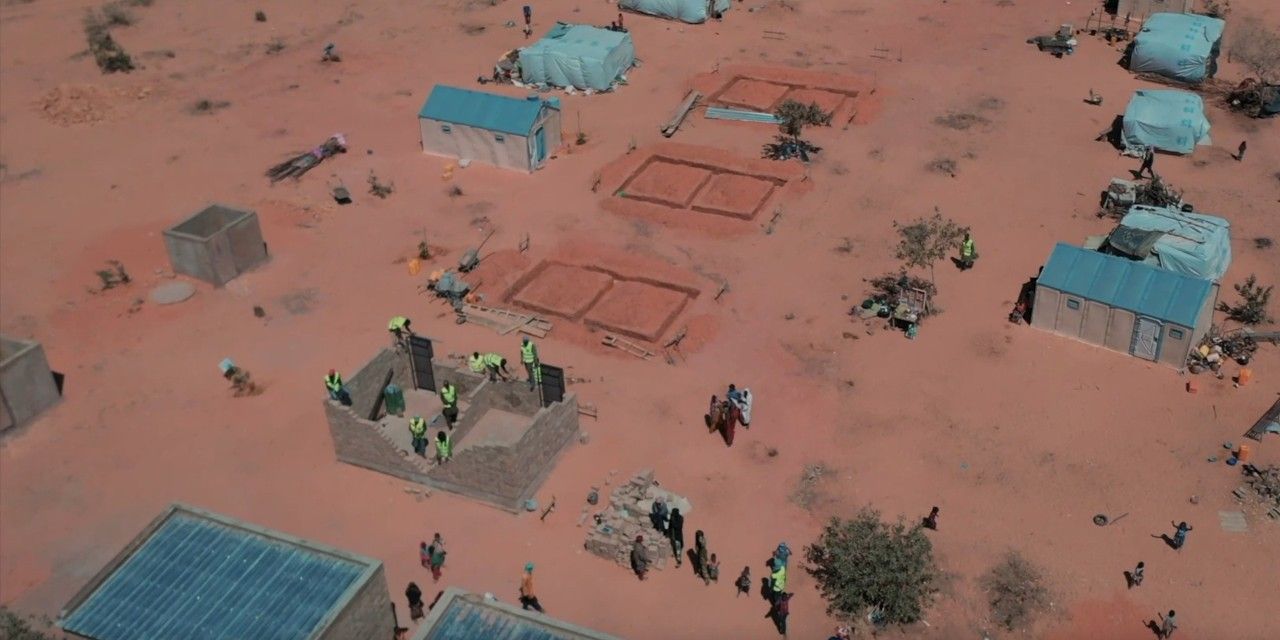
Humanitarian actors are integral part of the global effort against climate change. Their work often involves large-scale operations that can cause environmental degradation if not managed responsibly, particularly in the shelter sector. In the immediate aftermath of a disaster, as well as in protracted crises, construction and emergency shelter materials such as tarpaulins and tents and shelter construction materials may be distributed in large quantities, leaving significant environmental footprints.
The SDC is committed to supporting greener practices within the humanitarian sector. Together with the UNHCR, it co-founded the Geneva Technical Hub in 2021. This centre of expertise aims to support UNHCR field operations in environmentally sustainable activities in various sectors such as construction, housing, camp planning, water and sanitation, waste management and energy. It pools the innovative technologies and technical expertise of both Swiss federal institutes of technology in Lausanne (EPFL) and Zurich (ETHZ), the Swiss Federal Institute of Aquatic Science and Technology (Eawag), as well as the Swiss Humanitarian Aid Unit.
An Online Tool for Comparing the Sustainability of Shelter Design
As part of these efforts, UNHCR produced the «Shelter and Sustainability» report, setting a framework for assessing the sustainability of shelter designs. To operationalize it, UNHCR tasked the Geneva Technical Hub with creating a tool which could help decision-makers to choose between different shelter designs based on their environmental impact and other sustainability parameters.
«it’s basically a website comparing shelter designs» says André Ullal, member of the Swiss Humanitarian Aid Unit and the EPFL researcher leading the development of the Shelter Sustainability Assessment Tool. «We have assessed numerous shelter types from various places according to a range of sustainability criteria, including material production and transportation impacts, habitability, technical performance, and the use of local expertise.» A lot of effort was dedicated to making the tool accessible to users with various technical backgrounds and to ensuring the transparency of its background calculations. «We wanted to make the tool widely relevant and objective so that it could be used equally, for example, by a social worker in Rwanda or a structural engineer in Bangladesh» says the architect who has experience spanning both humanitarian and academic sectors.
Users can also compare the same shelter design in different contexts, considering that sustainability performance may vary depending on the contexts. The tool can generate several assessment and comparison reports to support users in making and communicating decisions about shelter design and procurement.
Promoting Local Construction Technics and Materials
The Shelter Sustainability Assessment Tool is part of a wider endeavour of the Geneva Technical Hub and the UNHCR to promote greener practices in the humanitarian shelter sector. It encourages the use of local expertise and resources as traditional construction techniques and design have several advantages. They tend to use building materials that are available in local markets with no necessity for long and costly supply chains. Beyond ecological considerations, traditional construction technics and designs also take into account cultural preferences. Since they have been used and applied for many generations, it is also easier to find local professionals to handle them.
All these efforts are good examples of how humanitarian workers can contribute to climate change adaption while supporting vulnerable communities.
Are you working in the humanitarian sector? Then try the Shelter Sustainability Assessment Tool.
Contact
Eichenweg 5
3003 Bern