
Switzerland and Tajikistan: two decades of continuous learning
After more than 20 years, the health sector partnership between Switzerland and Tajikistan has come to an end. Yet, there is no need to go as far as Asia to learn more about the long history of this alliance. In Switzerland, two doctors working in cooperation programmes for the training of medical staff have shared their experiences. The collaborative efforts undertaken by professionals have been a strong driver of change.
This year, the Eurasia Division of the Swiss Agency for Development and Cooperation (SDC) is making an inventory of its activities, and 2021 marks the 30th anniversary of cooperation between Switzerland and the former Soviet Union countries. Tajikistan is one of these countries. The partnership forged between Switzerland and Tajikistan in the health sector has recently come to a close.
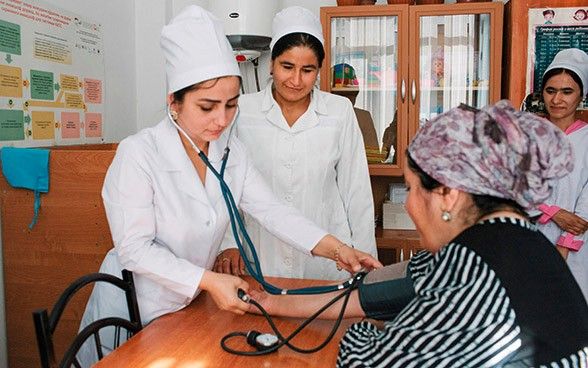
Today, although many challenges remain, major objectives have been achieved thanks, in particular, to international cooperation. This long-term collaboration has contributed to the achievement of important results, such as the introduction of the family doctor model. Over the past 20 years, the SDC has invested around CHF 44 million in 12 projects in specific areas such as medical training. It has provided assistance to the Tajik government on several fronts in order to strengthen the country’s health system. In health establishments, for example, the programmes implemented aimed to promote integrated services that were better adapted to patient needs. At the legal and regulatory level, the SDC supported the drafting of new laws to foster the practice of general medicine and regulate the work of family doctors.
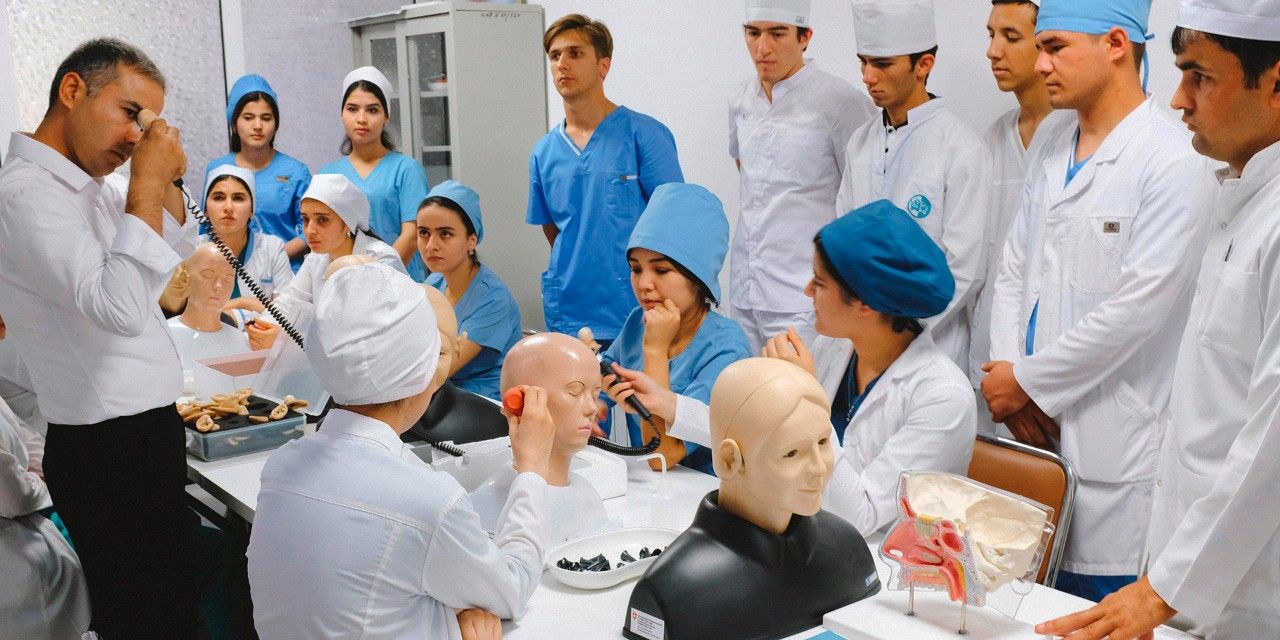
The activities conducted in the area of training (university, post-graduate and continuous) played an essential role. The projects were developed and implemented by health professionals from both countries.
Health system reform in Tajikistan and the value added of training
After the collapse of the Soviet Union in 1991, Tajikistan entered a transition period. The country, which currently has a population of around 9.5 million inhabitants, had to overcome major challenges, particularly regarding the reform of its health system. During the Soviet era, a basic health care system had already been established. Each village had one or several ‹reference points›, with at least one midwife and a feldscher (a Russian word of German origin), who was a well-trained medical worker responsible for providing primary care. As funding for these individuals ceased to be provided, many emigrated, particularly to Russia, or changed profession. The civil war between 1992 and 1997 and the decline of university education also influenced this migration. Furthermore, the international community was not aware of this health system. It therefore decided to develop, in cooperation with the Tajik government, a national strategy aimed at introducing, by 2020, a system based on general medicine, which was completely unfamiliar to the local population at the beginning.
Under the project ‹Medical Education Reform› led by the Tajik ministry of health, the SDC called upon Swiss specialised institutions, such as the Swiss Tropical and Public Health Institute (Swiss TPH), to develop a partnership with the Tajik government and support the reform of the education system for primary care doctors and nurses. Experts from both countries therefore worked in close collaboration and thereby developed professional relationships based on mutual trust. This knowledge-sharing network continues to be strengthened by the personal commitment of the stakeholders involved, who strive to promote the introduction of new practices, approaches and methodologies. For the SDC, working together on systemic changes is a key factor that influences the sustainability of the reforms also in the future.
Direct connections among family doctors
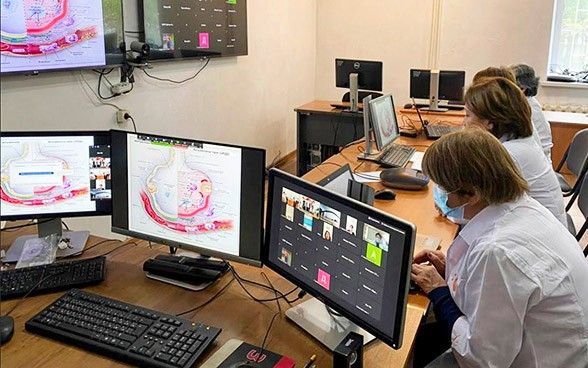
Former head of the Internal Medicine Service at the Cantonal Hospital of St Gallen, Renato Galeazzi, is one of the aforementioned experts. After retiring, he devoted himself to his work as a consultant for Tajikistan. In this capacity, he was responsible for assessing the quality of the reform project. Exchanges took places at several levels, among professors, doctors, nurses, interns and students, and focused on the comparison of diagnostics, interaction with patients and the organisation of work. From Dr Galeazzi’s point of view, linguistic communication, working approaches and also international cooperation expectations are all important aspects to be taken into consideration to «develop mutual trust over time and find a common language.»
Cooperation among professionals
Professor of international and humanitarian medicine for the Geneva University Hospitals, Louis Loutan, worked for many years in Tajikistan, and particularly in Kyrgyzstan. In Kyrgyzstan, which resembles Tajikistan in terms of its history and the type of cooperation programmes being carried out in the health sector, Louis Loutan led a project for the reform of medical training. According to the professor, the main strength of the programme lay not only in structural reforms but also in the exchanges among medical expert colleagues. «We share the same profession and therefore face the same problems in different environments,» explained Louis Loutan.
International cooperation
Switzerland's international cooperation is based on its Foreign Policy Strategy and aims to combat poverty in developing countries and to contribute to their sustainable development. Health is an essential factor in development: the SDC's health interventions focus on strengthening health systems, combating communicable and non-communicable diseases and improving sexual, reproductive, maternal, newborn and child health.
Contact
Eichenweg 5
3003 Bern