
WHY CARE? The podcast of the SDC
What impact do world events have on people locally? And why is the Swiss Agency for Development and Cooperation SDC addressing the challenges that arise from them? WHY CARE? The podcast provides answers and insights into the work of the SDC to alleviate need and poverty around the world, to foster respect for human rights, to promote democracy and to conserve the environment.

The SDC podcast was relaunched in October 2024 under the name WHY CARE? It is hosted by Don Sebastian in German and Charlotte Fahrni in French. Both work for the SDC. They discuss issues related to Switzerland's international cooperation with guests. Don't want to miss an episode? Subscribe to the podcast and stay up to date: Anchor, Apple Podcasts, Deezer and Spotify.
25.03.2026– Afghanistan: How is Switzerland helping on the ground?
Afghanistan is facing one of the gravest humanitarian crises of our time. Health, climate, food insecurity andaccess to education - the country has been enduring a multidimensional crisis for decades, while international funding continues to dwindle. For the past year, Switzerland has been back in the country, reopening its humanitarian office in Kabul to stay close to the population and better target its aid programme.
To gain a clearer understanding of the situation on the ground and Switzerland’s role, we invited Pamela Stathakis, Deputy Head of Mission in Kabul. On this month’s WHY CARE? podcast, she provides a rare insight into the realities of fieldwork. Drawing on her experience, Pamela Stathakis explores questions such as: What are the benefits of working directly on the ground? Can humanitarian action truly be effective when movement is restricted? And what can we learn from Afghan women about their daily lives in a country that denies them their fundamental rights?
18.02.2026 – Reorientation or struggle for survival? The future of humanitarian aid
In a world where crises unfold faster than responses can follow, humanitarian aid finds itself at a turning point. Organisations, both large and small, are facing unprecedented budget cuts, even as the demand for assistance intensifies. With nearly 250 million people in need of humanitarian assistance, the sector is being forced to rethink its priorities. Between the dwindling of funds and growth of political pressure, this crisis also represents an opportunity to overhaul the humanitarian system: the way we work and the way we think.
Dominik Stillhart, the Swiss Federal Council's delegate for humanitarian aid, discusses the alarming humanitarian situations he faced in 2025. In this episode of WHY CARE? he reflects on the growing challenges that the humanitarian sector currently faces and the solutions to be explored for the future. Stressing the urgent need for a change in mindset, he emphasises the necessity of testing new avenues and thinking beyond traditional models.
28.01.2026 – Recognise, repair, prevent: tackling conflict-related sexual violence
Conflict-related sexual violence continues to affect survivors long after hostilities have ended. Often overlooked, it must first be recognised before the issue of reparation can even be addressed. As a result, the right to reparation remains largely unenforced today. How can we establish forms of reparation that are truly useful and meaningful to those affected? How can we ensure that survivors have a voice? Who should we work with to prevent such violence in the future?
The Global Survivors Fund, an organisation created by Dr Denis Mukwege and Nadia Murad, both 2018 Nobel Peace Prize laureates, works to ensure access to reparation for survivors of conflict-related sexual violence. We invited its Head of Communications, Sarah-Eve Hammond, to answer these questions on WHY CARE?
26.11.2025 – Can artificial intelligence help save more lives?
The use of artificial intelligence in humanitarian aid and development cooperation is already a reality. It offers great potential, but also risks. Will artificial intelligence enable us to combat global poverty, halt climate change and save more lives in disasters and conflicts?
Till Trojer, guest on this episode of WHY CARE?, attempts to find a balanced answer to this question. He is a sociologist and ethnologist specialising in the sustainable and ethical use of artificial intelligence at the Swiss Church Aid (HEKS/EPER).
22.10.2025 – Realistic Peacebuilding – Between Diplomacy, Caution, and Clear-Sightedness
At a time when funding for peace is stagnating or declining, actors on the ground are striving to make their work sustainable by relying on existing structures. This episode of WHY CARE? explores the challenges of conflict prevention with Anne Grobet, expert in peace and development. Her sharp insight into the approaches used helps us better understand how stakeholders embed their actions within pre-existing security and administrative systems to prevent conflict and, step by step, build lasting peace.
24.09.2025 – Between source and crisis: water, a finite resource
Clean drinking water is still something that people in Switzerland take for granted, even though there has been increasing public debate about pesticides and PFAS in drinking water. Elsewhere in the world, the situation is much different. One in four people lacks the access to clean drinking water. Clean drinking water, an essential commodity, is increasingly becoming a scarce resource with the potential for conflict.
Ernst Bromeis, guest on the new episode of WHY CARE?, is a swimmer and activist who has dedicated himself to this issue. He tells us about his journey, his engagement as a “water ambassador” for the SDC-supported “Blue Peace” project, and about his expeditions, which have taken him from the waters of the Lower Engadine all the way to Bolivia.
27.08.2025 – A fresh perspective on international cooperation
What can we do to help in this constantly changing world? International cooperation is a field that is always changing and evolving in line with the needs and lessons learned from the crises we have faced.
Matilde Pozzi, Hanul Park and Sahar Bazaz tried to answer this very question, on the future of international cooperation, through research. In collaboration with the SDC, these three students have explored current interrogations from this field. Matilde Pozzi tells us more and gives an insight into how the next generation views international aid.
25.06.2025 – SDC History: The origins of Switzerland's international cooperation
1960: The Technical Cooperation Service, the forerunner of the Swiss Agency for Development and Cooperation (SDC), was founded. Today, 65 years later, it bears little resemblance to the organisation it once was. The development of Switzerland's international cooperation reflects changes at the global level. To better understand how Switzerland established its international cooperation over the years, Professor Sacha Zala begins with the origins of the SDC and answers questions such as: How has international cooperation shaped Swiss foreign policy? How did it become an integral part of Swiss identity? Does it compare to neutrality? And what position did Switzerland take during the Cold War?
27.08.2025 – A fresh perspective on international cooperation
What can we do to help in this constantly changing world? International cooperation is a field that is always changing and evolving in line with the needs and lessons learned from the crises we have faced.
Matilde Pozzi, Hanul Park and Sahar Bazaz tried to answer this very question, on the future of international cooperation, through research. In collaboration with the SDC, these three students have explored current interrogations from this field. Matilde Pozzi tells us more and gives an insight into how the next generation views international aid.
Give it a listen – let us know what you think! And if you'd like, you can help us spread the podcast to other listening ears, by subscribing, sharing and liking.
28.05.2025 – Humanity as a foundation: health and protection in humanitarian emergencies
The general perception of humanitarian aid is that it must be provided quickly, in emergency mode. Dr Olivier Hagon, Medical Director of the Swiss Humanitarian Aid Unit, anaesthetist and emergency doctor, is the guest on the eighth episode of the SDC podcast WHY CARE?. He describes humanitarian aid as a sensitive process that requires patience and the capacity to listen.
Dr Hagon believes that humanity is the key resource for providing medical care to people in the wake of disasters. Because disaster relief is ultimately driven by people who simply want to help others. He told us what it means to be a professional in humanitarian aid, the sacrifices he has had to make and challenges he has faced, but also what he has gained as a human being from these rich experiences. Now he hopes to pass the baton on to the next generation.
23.04.2025 – The UN does not only work in New York or Geneva: a field report
The image of the United Nations is often associated with the General Assembly in New York or the Palais des Nations in Geneva. However, the work of the UN in various areas such as health, agriculture and children's rights takes place primarily on the ground with the people themselves. Victoria Martinez works for UNICEF, the United Nations Children's Fund. She is Chief Field Operations in Cameroon and is responsible for the implementation of projects. She gives us an insight into field work and explains the importance of UN organisations in international cooperation.
26.03.2025 – When funding decreases, suffering increases
Humanitarian aid alleviates human suffering. As funding dwindles, humanitarian projects have to be terminated . Those in need are left behind. What are the consequences of the USA’s, Germany’s, France’s or the Netherlands’ but also Switzerland’s cuts to international cooperation? How to adapt to these changes and what are the implications for those affected? To respond to these questions, we have invited Margot Fortin, Global Programme Coordinator at Impact Initiatives. Through concrete facts and figures, she gives us key insights to better understand this global challenge.
26.02.2025 – Three years of war in Ukraine: a personal account from the humanitarian front
Over the past three years, Swiss humanitarian aid in Ukraine has repeatedly had to adapt to the war situation. It shifted to the front line, increased in scope and worked ever more closely with local organisations. This programme is one of the largest in the history of Swiss humanitarian aid. After six years of humanitarian work in Ukraine, Mario Trutmann hopes that this programme will be remembered as one of the most innovative and effective. Listen to an account of his experiences after six years of humanitarian work in Ukraine.
29.01.2025 – Investing in the future: private capital for sustainable development
Where are the limitations and risks when private capital seeks profits in development cooperation? Thierry Buchs from the SDC provides answers.
18.12.2024 – «Cash is King», even in humanitarian aid?
«People affected by crisis situations know best what they need, when they need it and how.»
Stefan Bumbacher, guest of the third episode of WHY CARE?, explains the benefits of the Cash & Voucher Assistance approach in humanitarian crisis situations. It provides a faster, more effective, and cost-efficient response. Most importantly, it puts the needs of the affected people at the center of the intervention, allowing them to regain a sense of dignity. While it is not the ideal solution for every situation, cash assistance complements a range of humanitarian aid mechanisms, each designed to best address the specific challenges of different contexts.
20.11.2024 – Safety, a collective good
«Security belongs to everyone», this simple statement is what Nathalie Chuard, Director of DCAF, the Geneva Centre for Security Sector Governance, brought back from her trip to Africa last year. Security is essential to sustainable development, both for local populations and for the international community as a whole. In this episode of WHY CARE?, Chuard explains how international cooperation is helping to make the world a safer place and why, especially in times of rising insecurity, investing in it is more crucial than ever.
16.10.2024 – Hot spots of the world
As director of the SDC, Patricia Danzi does not just manage the organization from her office in Zollikofen near Bern. She regularly travels to crisis regions. She personally assesses the suffering and needs on the ground. She absorbs her impressions into her work. So that suffering can be alleviated in the short term and security and prosperity secured in the long term. In this episode of WHY CARE, she shares her impressions from Sudan, Ukraine and the Middle East
Earlier podcast episodes under the name A Plus For Humanity
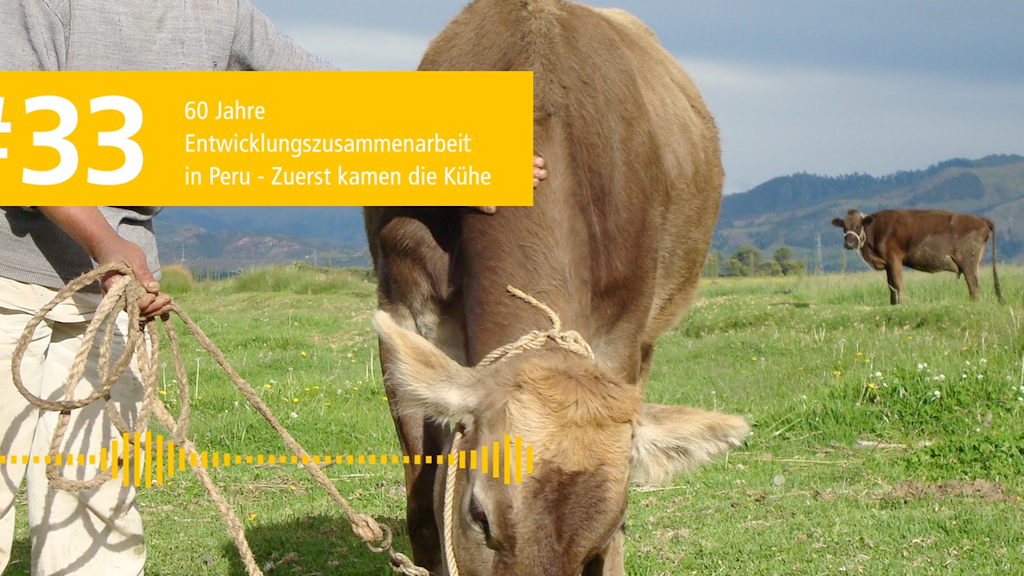
A Plus For Humanity: the SDC podcast
Every month, the SDC podcast A Plus For Humanity reports on international cooperation and humanitarian aid projects.
Contact
Eichenweg 5
3003 Bern