Switzerland’s international cooperation strategy 2025-2028
The International Cooperation Strategy 2025-2028 adopted by Parliament in December 2024 sets out Switzerland’s priorities for development and economic cooperation, humanitarian aid and the promotion of peace and human rights. The overarching objective of international cooperation is to end poverty and support sustainable development worldwide. It is an integral part of Swiss foreign and security policy.
Saving lives and ensuring access to basic services; contributing to sustainable economic growth; protecting the environment and combating climate change; promoting peace and human rights, and strengthening democracy and the rule of law. These are the objectives set by Switzerland’s International Cooperation Strategy 2025-2028. It thus continues to focus on the priorities of the previous strategy (2021-2024), thereby ensuring the coherence of Switzerland’s contribution to global sustainable development.
The strategy is implemented by the SDC and the Peace and Human Rights Division (PHRD) of the FDFA and the State Secretariat for Economic Affairs (SECO) of the Federal Department of Economic Affairs, Education and Research (EAER).
International cooperation activities are based on a constitutional and statutory mandate. The International Cooperation Strategy forms part of the Federal Council’s cascading strategy, which strengthens the coherence of Swiss foreign policy and foreign economic policy.
The four international cooperation development objectives for 2025-2028
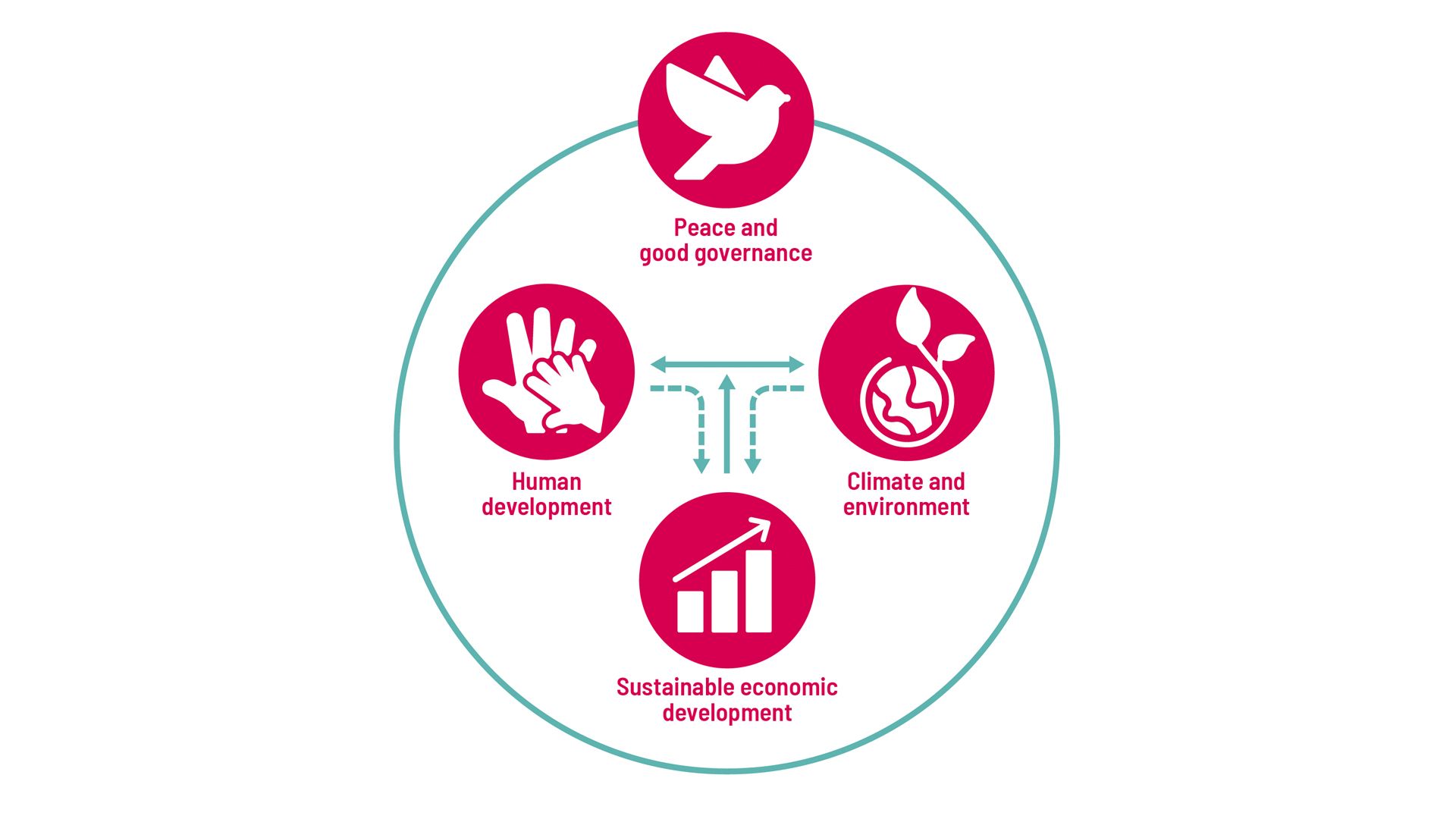
Switzerland pursues its international cooperation objectives in line with its thematic priorities and promotes gender equality, good governance and respect for human rights in all its activities. The four development objectives of international cooperation are interrelated and mutually reinforcing.
Human development
Saving lives, alleviating human suffering and providing access to high-quality basic services for the most disadvantaged: United Nations estimates indicate that 339 million people worldwide were dependent on humanitarian aid in 2023 and around 117 million had been displaced or were stateless – both distressing negative records. International cooperation has therefore implemented disaster protection measures to reach people in emergency situations and to enable migrants and those forcibly displaced to secure their livelihoods. The COVID-19 pandemic had a devastating impact on basic services. And it also led to setbacks in medical care, for example for tropical and non-communicable diseases and in the area of sexual and reproductive health. For this reason, Swiss international cooperation has raised awareness about the prevention of non-infectious diseases through information events and will step up its efforts in this area in future.
Sustainable economic development
Create decent jobs by establishing suitable framework conditions and fostering a vibrant local economy and private sector: economic crises, the rising cost of living and high inflation have a disproportionately strong impact on low-income countries. People on low incomes and disadvantaged groups are at particular risk of slipping deeper or falling back into poverty. This is why international cooperation supports the creation of decent jobs and the strengthening of economic framework conditions, and promotes the local private sector.
Climate change and the environment
Guarantee environmentally friendly development, resilient to climate change and natural hazards, for the benefit of the most disadvantaged: Over a third of people live somewhere that is seriously jeopardised by climate change, exacerbating existing vulnerabilities. Extreme weather events, loss of harvests and water shortages have increased again, jeopardising the food security of millions of people. Half of the world’s population will live in water-scarce regions by 2025. International cooperation therefore supports the development of sustainable, resilient measures against the negative consequences of climate change.
Peace and governance
Resolving conflicts, promoting peace: around a quarter of the world’s population lived in conflict-affected regions at the beginning of 2023. Russia’s war of aggression on Ukraine has definitively reminded us that peace in Europe cannot be taken for granted. In various contexts, authoritarian tendencies have increased and the erosion of the rule of law has intensified, and the world is a long way from achieving gender equality. Through its international cooperation activities, Switzerland endeavours to establish and secure peace, helps governments to set up governance systems and promotes the principles of the rule of law.
Major crises have changed the security situation around the world. The consequences of the COVID-19 pandemic, the war in Ukraine, the escalation in the Middle East, the energy crisis, food insecurity, the debt burden, inflation and climate change have a direct impact on developing countries, but also on Switzerland. The number of people living in extreme poverty, which has risen for the first time in 30 years, is one example. Furthermore, the number of people in need of humanitarian aid is significantly higher today (339 million) than in 2019. About a third of the population of Ukraine have been displaced because of the war.
In order to cope with the paradigm shift, adjustments have been made since the International Cooperation Strategy 2021-2024, such as increasing the humanitarian aid credit and identifying ten specific objectives based on the current challenges.
In an increasingly unstable world, international cooperation strengthens Switzerland’s credibility and influence at a global level. It helps to promote the values that characterise Switzerland: the rule of law and democracy, the market economy, human rights, dialogue, solidarity, humanitarian principles and humanitarian law.
International cooperation is guided by three principles:
the needs of the affected population;
the specific added value that Switzerland can contribute;
Switzerland’s long-term interests (such as a peaceful and just international order, stable and investment-friendly economic conditions, addressing the causes of displacement and irregular migration, and global sustainable development).
The financial framework of international cooperation for the 2025-2028 period
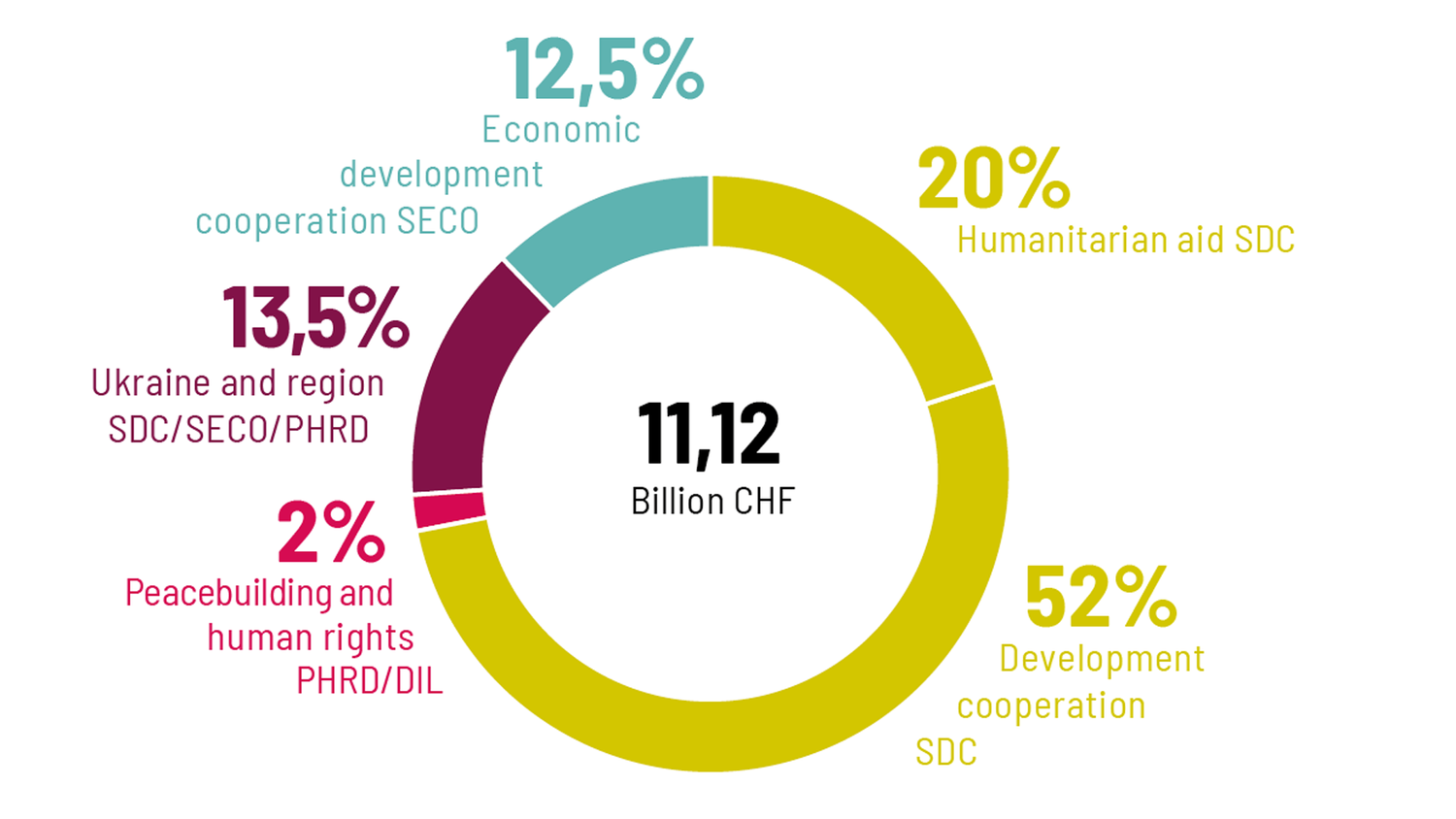
Parliament has set a maximum financial framework of CHF 11.12 billion for the International Cooperation Strategy 2025-2028 with five commitment appropriations. CHF 1.5 billion is earmarked for supporting Ukraine and CHF 1.6 billion for combating climate change.
The actual budget is approved annually by Parliament. Parliament has made nearly CHF 2.5 billion available for 2026.
The five commitment appropriations form the maximum financial framework. The budget and the financial plan represent the funds actually available. The SDC realises 73% of the five commitment appropriations through humanitarian aid and development cooperation. The PHRD’s peacebuilding and human rights activities account for 2%, while SECO’s economic development cooperation accounts for 12%. Lastly, the Ukraine and region programme, implemented jointly by the SDC, PHRD and SECO, accounts for 13%.
Priority countries for international cooperation 2025-2028
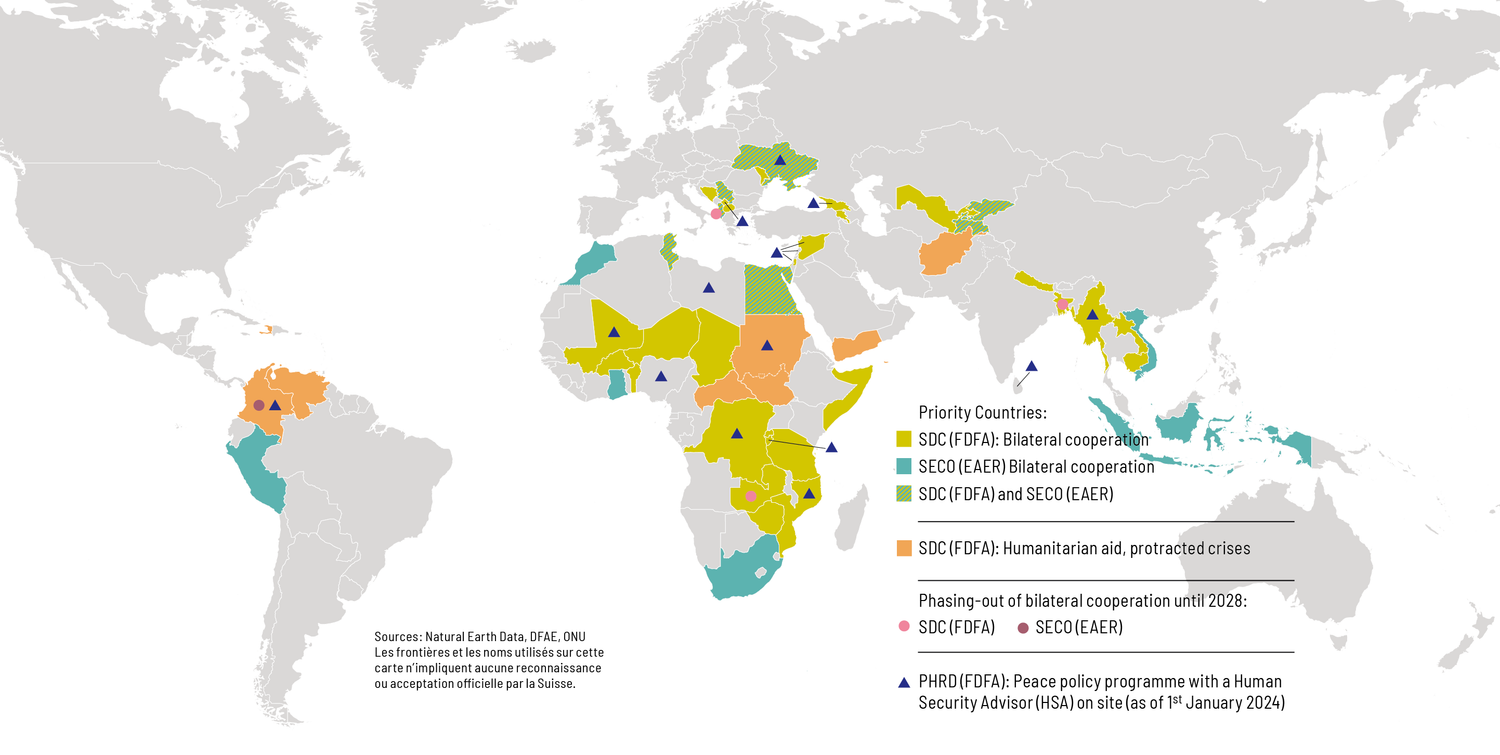
Even though the war in Ukraine and its consequences have a significant place in this strategy, Switzerland’s humanitarian tradition and its interests require it to maintain its activities in the rest of the world. The four priority regions of the 2021-2024 strategy – sub-Saharan Africa, the Middle East and North Africa, Asia and Eastern Europe – will be retained. Switzerland will mainly focus its international cooperation activities on 40 priority countries and seven protracted crises.
As part of the ongoing prioritisation and adjustment to the new financial framework, Switzerland will end bilateral cooperation in Zambia and Bangladesh by 2028. In Albania, only economic development cooperation will be continued from 2029.
Frequently asked questions (FAQs)
International cooperation includes humanitarian aid, development cooperation and economic cooperation activities as well as measures to promote peace and strengthen human rights.
International cooperation’s general goal is to combat poverty and support sustainable development in its three dimensions – economic, environmental and social. To finance these activities, the Federal Council submits the Dispatch on Switzerland’s International Cooperation Strategy to Parliament, combined with a request for commitment appropriations for a four-year period, in order to be able to plan Switzerland’s activities in the longer term.
International cooperation promotes peace and security and creates opportunities for local populations. In 2024, in the annual study on security carried out by ETH Zurich, 76% of participants indicated they were in favour of Switzerland stepping up mediation efforts or other means of supporting dialogue between the parties involved in conflict and around 58% thought that Switzerland should increase its development aid.
Greater prosperity
As recognised in Switzerland’s foreign economic policy, an open and heavily globalised economy is a key factor in Switzerland’s prosperity as an export-oriented country. By contributing to income growth and favourable conditions for investment in developing countries, international cooperation enables Swiss companies to access new markets in these countries and has an indirect positive effect on Switzerland’s economic development.
Ensures independence and neutrality
The increase in the number of crises and the international rules-based system being called into question have a direct impact on Switzerland’s security and independence in the medium and long term. Switzerland’s international cooperation its multilateral commitment and its good offices have created a climate of trust and have acted as a door opener. This means it can also effectively protect its independence and represent its interests when international rules are being defined. In its capacity as a neutral country free of any alliance, it needs to find partners on the international stage.
Answers to global challenges
The current global challenges in fields such as the environment, migration, security and health are also having an impact in Switzerland (climate change, asylum, terrorism, pandemics, etc.). Countries cannot face such challenges in isolation but must join forces at the international level. Their joint action is also contributing towards preserving the livelihoods of future generations in Switzerland.
Alternatives to irregular migration
Through its activities in poor or crisis-affected countries, Switzerland is opening up economic, political and social prospects in migrants’ countries or regions of origin. In this way, it promotes medium and long-term alternatives to irregular migration.
Contribution to International Geneva
International cooperation raises Switzerland’s profile abroad and makes Geneva a more attractive location for international organisations to have their base. International Geneva’s total contribution to Switzerland’s GDP is estimated at 1%.
Stimulus for the Swiss economy
Official development assistance (ODA) also has a positive impact on the Swiss economy by stimulating demand for Swiss goods and services by creating incentives for additional activities undertaken by the private sector or NGOs, or by indirectly boosting the purchase of goods and services by multilateral organisations from Swiss companies.
Humanity has achieved unprecedented progress in terms of prosperity, health, security and quality of life over the past 50 years. International cooperation has contributed to this progress.
Thirty years ago, 35% of the world’s population (1.8 billion people) lived in extreme poverty. In 2019, the figure stood at 8.4% (648 million).
Infant mortality has fallen by a factor of 2.5 since 1990, while the universal health coverage index climbed from 45 in 2000 to 67 in 2019.
Between 2012 and 2017, the income of the poorest 40% of the population in 53 countries grew faster than the national average, indicating inclusive growth.
In 2001, 64 countries were categorised as low-income countries; by 2023, this figure had fallen to 28.
Switzerland’s contribution
This progress was made possible in part thanks to Switzerland’s contribution. Here are some examples from the interim report and the accountability report on the implementation of the Dispatch on the International Cooperation Strategy 2021-2024:
8.9 million people were given access to affordable drinking water.
More than 16.2 million people benefited from climate change adaptation measures and around 69 million tonnes of CO2 emissions were avoided.
1.3 million people took part in vocational training programmes.
510,000 jobs were created, maintained or improved (generation of higher incomes, formalisation or more humane working conditions).
The Swiss Humanitarian Aid Unit (SHA) carried out 660 missions in 73 countries.
Switzerland supported and made a significant contribution to 21 peace processes (including Colombia and Libya) and conducted ceasefire negotiations in seven countries (including Myanmar and Nigeria).
Between 2020 and 2022, 59% of expenditure (CHF 3.7 billion) was allocated to projects that took into account gender equality.
But today that progress is under threat
The world has experienced significant upheaval since 2020, including the COVID-19 pandemic, conflicts such as the war in Ukraine, climate change and economic crises with far-reaching health, economic and social repercussions. In 2020, extreme poverty rose for the first time in 30 years. Promising advances in terms of sustainable development were interrupted or reversed.
In this climate, Swiss international cooperation has helped individuals, groups and states to overcome crises and conflicts and to strengthen their long-term resilience. It has flexibly adapted existing projects and programmes, where necessary, to new circumstances and requirements without losing sight of the long-term picture and the work on addressing the deep-rooted causes of such crises.
The four overarching objectives have proven effective in tackling new and existing challenges, which means they will be continued in the new strategy for 2025-2028.
In a globalised world, economic, political and social problems in one region quickly have a negative impact on other countries. That is why joint action is required at the international level.
In 2023, an estimated 339 million people in 69 countries required humanitarian assistance. The number of displaced people reached 100 million in 2022. The effects of global warming are resulting in more natural disasters, such as forest fires, hurricanes, flooding and drought. The World Bank estimates that between 32 and 132 million people could fall into extreme poverty by 2030 and that 216 million will be displaced within their own countries by 2050 unless targeted action is taken to protect the climate and promote development.
Because of these crises, hunger already affects one tenth of the world’s population. In 2021, the Democracy Index saw its sharpest fall since 2010, with the erosion of rights mainly affecting women and minority groups. In humanitarian contexts, gender-based violence affects up to 70% of women and girls. Debt crises are emerging again in many developing countries in a new geopolitical climate.
international cooperation is a foreign policy instrument that enables Switzerland to take action to tackle these global challenges. It promotes the values that represent Switzerland’s strengths: the rule of law and democracy, the market economy, human rights, gender equality, dialogue, solidarity, the integration of minorities and humanitarian principles.
Switzerland’s activities are designed for the long term, in order to consolidate results already achieved. The strategic framework for the period 2021-2024 proved effective. It enabled Switzerland to react in a flexible and agile way to the crises which emerged over recent years, contributing to a well-coordinated and coherent response while continuing to work towards the achievement of long-term goals. The general strategic direction will thus be maintained for the 2025-2028 period.
However, the following adjustments are made to reflect the current context and in response to the budget cuts approved by Parliament at the end of December 2024 (see press release dated 29 January 2025):
The commitment appropriation for humanitarian aid has been increased.
The Ukraine country programme has been expanded, increasing the budget to CHF 1.5 billion, with CHF 500 million reserved for the involvement of the Swiss private sector.
The list of priority countries has been revised to now include countries affected by protracted humanitarian crises. At the same time, bilateral development cooperation in Bangladesh, Albania and Zambia will be discontinued by the end of 2028.
A special focus will be placed on certain challenges requiring greater attention, for example the climate and democracy.
Multilateral engagement focusing on global challenges (peace, security, climate, new technologies etc.) will be strengthened.
Planned measures will be more focused on people, and will be managed as far as possible by local actors to ensure that they are relevant and sustainable.
More will be done to leverage Swiss expertise, which is in demand and recognised internationally, in particular in fields such as federalism, vocational education and training, mountain ecosystems and technological innovation. This will be achieved by promoting an inclusive approach in collaboration with the relevant Swiss actors from academia, the private sector, NGOs, and public administration.
With the new strategy, five commitment appropriations totalling CHF 11.12 billion are available for international cooperation for the 2025-2028 period. The Federal Council had requested CHF 11.27 billion. The annual budget is approved by Parliament. Parliament has made a cut of CHF 110 million for this year, meaning a total of CHF 2.4 billion is available for 2025.
Switzerland’s ODA includes contributions from the Swiss Confederation, the cantons and the communes to promote economic and social development in the recipient countries. It totalled CHF 4.053 billion in 2024, equivalent to 0.51% of GNI. Excluding asylum costs, expenditure chargeable to ODA fell by CHF 338 million compared to the previous year. As a result, the ODA/GNI ratio excluding asylum costs fell from 0.43% (2023) to 0.38% (2024). It is difficult to forecast the ODA/GNI ratio for the 2025-2028 period, as GNI can only be estimated, and asylum costs are volatile due to the international context.
Ukraine has been a priority country for Swiss international cooperation since 1999. In its work on the ground, Switzerland can therefore build on long-standing partnerships and activities. Switzerland immediately became involved in Ukraine with humanitarian measures when the war broke out. By 31 December 2023, Switzerland had allocated CHF 2.75 billion, including CHF 400 million for humanitarian measures and cooperation, via the three responsible organisational units (SDC, PHRD and SECO) since the start of the war. Switzerland has also strengthened its bilateral cooperation with Moldova, which neighbours Ukraine, in order to mitigate the effects of the war and contribute to stability in the region. Switzerland’s response to the conflict in Ukraine is based on two strands, with CHF 1.5 billion being allocated under the current strategy.
Over the next four years, Switzerland will make CHF 860 million available for humanitarian aid, peacebuilding and development cooperation through the SDC and PHRD. CHF 640 million, including CHF 500 million for cooperation with the Swiss private sector, will be allocated to economic development cooperation implemented by SECO.
Since 1 January 2025, the Federal Council’s delegate for Ukraine, Jacques Gerber, has been responsible for managing the joint country programme for Ukraine (see press release of 12.02.2025). The units responsible for Ukraine within the SECO, the SDC and the PHRD report directly to him for all activities related to the implementation of the programme. This enables clear management and implementation across the administrative units. In his new role, Mr Gerber will report to the heads of the FDFA and EAER. He was awarded the title of ambassador to fulfil his new role.
The programme for Ukraine is based on the seven Lugano Principles:
Das Programm für die Ukraine orientiert sich an den sieben Lugano-Prinzipien:
Partnership
Reform focus
Transparency, accountability and the rule of law
Democratic participation
Multi-stakeholder engagement
Gender equality and inclusion
Sustainability
It is also based on the following elements:
A balanced bilateral and multilateral approach: use of appropriate bilateral and multilateral channels to implement the programme, taking into account Switzerland’s visibility.
Cooperation with the private sector to promote economic recovery: Swiss and Ukrainian companies are to participate in the economic recovery.
Use of various instruments: non-repayable contributions, loans, participations and guarantees are to be used to implement the programme.
Clarity and accessibility: the benefits of the activities must be communicated at the national and international levels in order to ensure understanding and traceability. The activities must reflect Switzerland’s expertise and enable recognition at the international level.
Exit strategy: regardless of how the war develops, Switzerland must be in a position to withdraw in an orderly manner. The situation will be kept under regular review.
International cooperation helps to reduce the causes of forced displacement and irregular migration in three ways:
In the short term, it helps to reduce the causes of forced displacement, improve the living conditions of displaced persons and protect refugees in their first country of refuge.
In the medium term, it aims to create local opportunities to provide alternatives to irregular migration and to find the best possible solutions for the integration of migrants and persons forcibly displaced in developing countries.
In the long term, it seeks to address the underlying causes of irregular migration – such as poverty, lack of access to basic services, armed conflicts, poor governance and environmental degradation, particularly the consequences of climate change.
The strategic link between international cooperation and migration policy is to be strengthened at three levels:
At the political level, migration is an issue that must be addressed consistently during political consultations. The Federal Council aims to enter into further migration agreements and partnerships.
At the geographical level, the country strategies consistently take account of migration. Greater financial flexibility will enable Switzerland to take advantage of opportunities in relation to migration policy more effectively – including beyond priority countries.
At the thematic level, international cooperation programmes take account of migration and forced displacement, for example as part of projects focusing on the prevention, protection and integration of migrants or the creation of economic, political and social prospects in their countries of origin.
The climate and environment are included in Switzerland’s four main international cooperation objectives for 2025-2028. Developing countries and low-income populations are hardest hit by the effects of climate change. Conversely, middle-income countries are seeing a strong growth trajectory in their greenhouse gas emissions. Faced with these challenges, Switzerland is taking action at various levels:
Adaptation and mitigation
Switzerland is strengthening the resilience of developing countries through efficient adaptation mechanisms but is also contributing to the reduction of greenhouse gas emissions through climate action (for example: urban development with low CO2 emissions).
Risk reduction
International cooperation also supports risk-reduction measures to protect populations and limit financial losses and helps to conserve biodiversity, ecosystems and related services.
Bilateral and multilateral cooperation
Switzerland also takes part in international negotiations on climate change, working with governments and financial institutions to achieve the goals set by the Paris Agreement.
Furthermore, the International Cooperation Strategy 2025-2028 focuses on three specific objectives to meet the challenges of climate change: 1) combating hunger 2) sustainable use of water resources 3) the energy transition.
In total, Switzerland’s international cooperation will contribute CHF 1.6 billion to the financial climate targets over the four years. Switzerland’s financial international cooperation commitment complements other allocations, such as the commitment appropriation for the global environment approved by Parliament on 8 March 2023 (dispatch concerning a commitment credit for the global environment 2023-2026 (German) as well as other instruments.
Switzerland will focus on four priority regions which have the greatest needs, are central to Switzerland’s interests and where international cooperation activities can generate added value:
Sub-Saharan Africa
Middle East and North Africa
Asia
Eastern Europe
With regard to bilateral development cooperation, the SDC has reduced its long-term commitment from 35 to 34 priority countries. For budgetary reasons, the SDC will also withdraw from three other priority countries by the end of 2028. SECO is maintaining its engagement in the 13 priority countries of the International Cooperation Strategy 2021-2024, with the exception of Colombia, where it plans to move towards other types of economic cooperation and exit international cooperation by the end of 2028. Morocco will become a new priority country for SECO.
In the context of humanitarian aid, the mandate is universal. Although disaster response needs (e.g. for earthquakes, floods, famines, cholera outbreaks) cannot be predicted for the period 2025-2028, many of the protracted crises require a humanitarian commitment that spans several years.
Peace policy is handled in a flexible, agile manner, in order to have room for manoeuvre for adjustments and to take advantage of opportunities. It is foreseen that efforts will be concentrated on up to 20 contexts.
Humanitarian aid, multilateral activities and global programmes (climate and environment, water, migration, health and nutrition) as well as measures to promote peace and human rights retain a universal mandate. Although they will be concentrated on the four priority regions, they will also be deployed beyond those regions.